
The H.U.M.A.N. Model is built like a blueprint for enterprise communication and engagement capability. Each Dimension, represented by a letter, shows one condition communication must preserve so people can understand, trust, act, and adapt across complexity.
Most organizations are not starting from nothing. They already have communication strengths, habits, tools, channels, leaders, managers, and practitioners to build on. Some may be strong in MOBILIZE, with effective delivery, channels, messages, and materials, while needing more strength in HEAR, UNIFY, ASSURE, or NURTURE. Others may have strong listening, leadership trust, or learning practices, but need stronger structure for meaning, execution, or reinforcement.
The blueprint style reflects the idea that stronger communication capability is designed and built from real organizational experience. The Model brings together the practical knowledge of executives, communication practitioners, managers, and frontline teams into a shared architecture that can help organizations see what is already working, where capability may be uneven, and what needs to be strengthened across industries, functions, levels, and environments.
The H.U.M.A.N. Enterprise Communication and Engagement Model Architecture
Built By Humans, For Humans


H: HEAR Dimension
The HEAR Dimension is where communication begins. Before an organization decides what to say, it must understand the business reality, human conditions, stakeholder concerns, operational pressures, and environmental factors that will shape how communication is received.
For executives, HEAR asks whether the organization has enough visibility into the conditions surrounding a priority, decision, change, issue, or commitment. A message may be strategically correct, but it can still fail if it does not reflect what employees, managers, customers, communities, or stakeholders are actually experiencing.
For practitioners, HEAR provides the discovery discipline behind better communication. It helps communicators look for workflow realities, manager readiness, access needs, trust conditions, communication saturation, competing signals, and likely interpretation risks before communication moves forward.
HEAR helps ensure communication is designed from reality, not built on assumption.

U: UNIFY Dimension
The UNIFY Dimension focuses on shared meaning. Communication can be accurate, approved, and distributed, but still fail if people interpret it differently. UNIFY helps clarify what matters, why it matters, what is changing, what remains stable, what action may be expected, and what meaning must hold across different audiences and environments.
For executives, UNIFY helps protect strategic intent as it moves through leaders, managers, teams, channels, and stakeholder environments. It reduces the risk that one priority becomes many different interpretations once it reaches different parts of the organization.
For practitioners, UNIFY is where message architecture, narrative clarity, stakeholder relevance, proof points, manager-ready meaning, and priority clarity come together. It is not about forcing identical language everywhere.
UNIFY is about preserving the same essential meaning while making it usable from the boardroom to the frontline.

M: MOBILIZE Dimension
The MOBILIZE Dimension is where communication becomes active. After the organization has heard the relevant realities and unified the essential meaning, MOBILIZE focuses on creating, packaging, sequencing, delivering, and supporting the communication people will actually experience.
It includes the messages, materials, channels, timing, ownership, manager support, source-of-truth practices, escalation paths, and reinforcement planning needed to move communication from shared meaning into coordinated action.
For executives, MOBILIZE asks whether the communication that has already been shaped is being activated with the ownership, timing, channels, support, and readiness needed to work in the organization. People may understand the message and still be unclear about what happens next, who owns what, where questions should go, what managers are expected to reinforce, or how the communication connects to the work system. MOBILIZE helps leaders see whether the organization is prepared to turn aligned meaning into coordinated action.
For practitioners, MOBILIZE is where communication planning becomes operational. It is where the practical deliverables people experience are created and activated, including announcements, leader messages, town halls, talking points, manager guides, FAQs, channel plans, stakeholder materials, and support resources. MOBILIZE is where the blueprint becomes buildable.
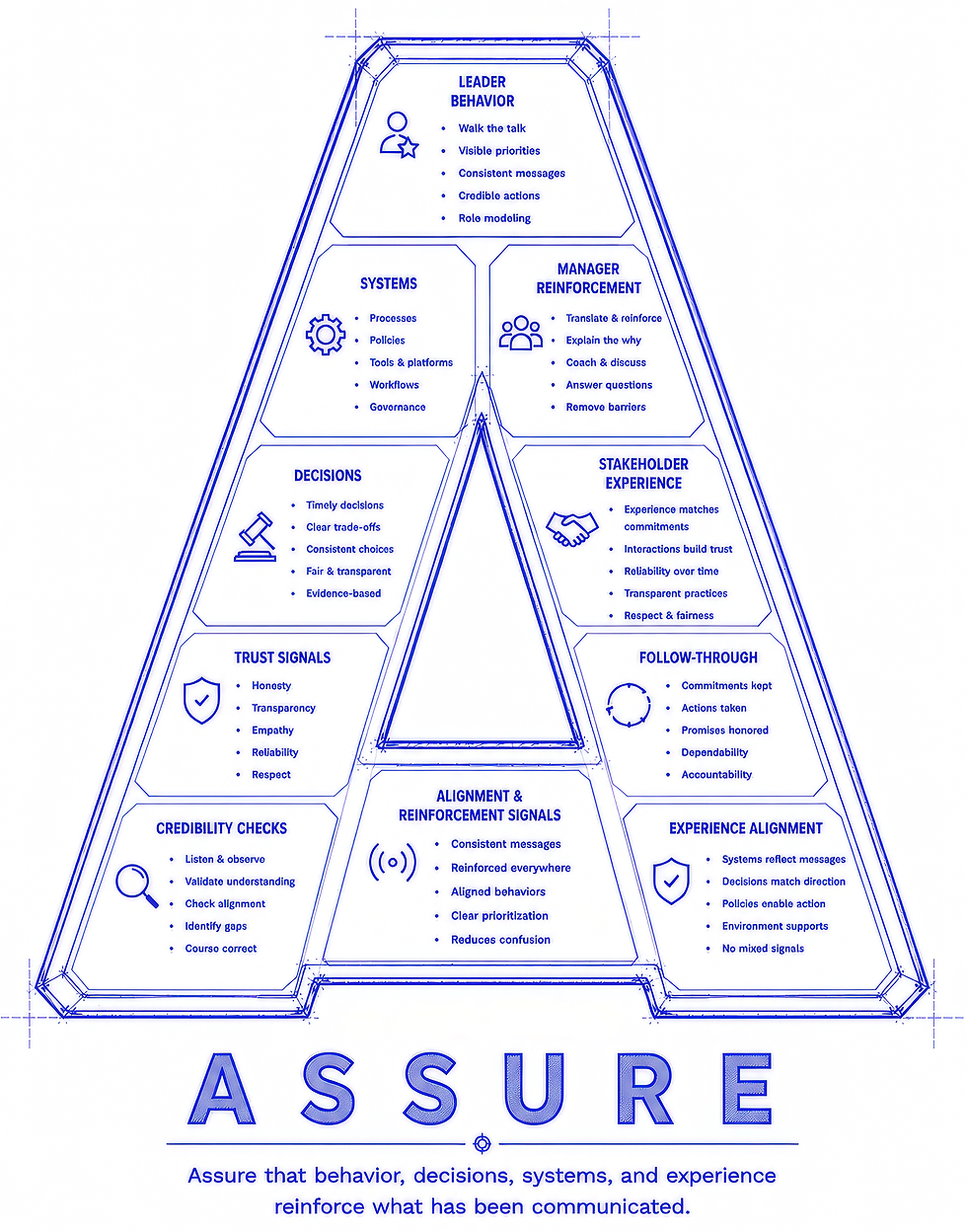
A: ASSURE Dimension
The ASSURE Dimension focuses on credibility after communication is delivered. People decide whether communication can be trusted by watching what happens next. They look at leadership behavior, manager reinforcement, decisions, systems, policies, workflows, accountability, stakeholder experience, and follow-through.
For executives, ASSURE asks whether the organization is reinforcing what it communicated. A message can be clear at launch and still lose force if leaders move on too quickly, managers are unsupported, systems reinforce something different, or stakeholders experience a gap between the organization’s words and actions.
For practitioners, ASSURE provides the discipline for testing whether communication remains believable in practice. It looks for trust signals, reinforcement gaps, repeated questions, stakeholder response, operational proof, manager feedback, and alignment between communication and experience.
ASSURE helps determine whether the communication is holding up in real organizational life.

N: NURTURE Dimension
The NURTURE Dimension focuses on learning and improvement over time. Communication does not remain effective simply because it was clear at launch. Conditions change. People forget. Priorities shift. Managers get busy. Stakeholders respond in unexpected ways. New questions emerge.
For executives, NURTURE asks whether the organization is learning from what people understood, trusted, questioned, experienced, and did. It helps move communication from a project-by-project activity into a more durable enterprise capability.
For practitioners, NURTURE is where feedback, evidence, lessons learned, manager experience, stakeholder response, measurement, capability development, and continuous improvement become part of the communication system.
NURTURE keeps the Model from becoming static. It helps communication capability improve as organizations, technologies, stakeholders, and work environments evolve.
How the Dimensions Work Together
The five Dimensions are connected.
Communication may fail if it begins without enough reality, if meaning fragments, if action is unclear, if reinforcement is weak, or if the organization does not learn from what happened.
Together, HEAR, UNIFY, MOBILIZE, ASSURE, and NURTURE help leaders and practitioners see communication as a human-centered enterprise capability, not just a set of messages, meetings, channels, campaigns, or content.